
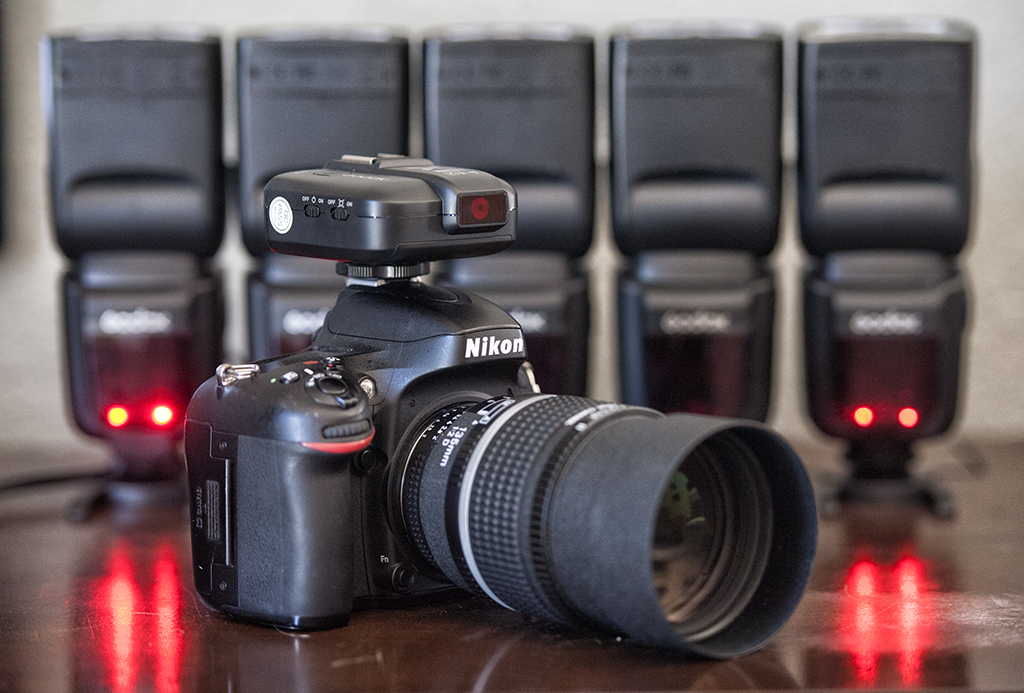
Godox Flash and Speedlight Review:
Original review written Jan 2018, updated May 2019
QUICK SUMMARYPros:
•Low Price •Built in transmitter/receiver function in all lights •Relatively Reliable Cons: •Cheap build quality on some speed-lights (TT series) •Very unreliable when using two shooters sharing the same channel DETAILED SUMMARY Introduction – My need for the Godox System: Until the past few years, aftermarket options on lighting accessories were slim if you wanted a quality product. There have always been companies that have made lighting accessories, but it was incredibly challenging to find a product that was reliable, built well and worked seamlessly with your existing equipment. The only aftermarket options out there for firing speed lights remotely were Pocketwizards, and while they work incredibly well, they were also expensive. I used them for years in partnership with my Nikon speed lights, Norman and Paul C Buff strobes, but the equipment I had to lug around didn’t fit my shooting style, so I looked for a more compact option. Flash back to a couple years ago when Nikon and Canon both released speed lights with built in radio triggers. Finally, a way to remotely and accurately fire flashes without additional equipment! There was only one problem: the flashes were $600 each! Even as a full-time pro, I couldn’t justify (and still can’t) spending $600 per flash, especially when I needed a minimum of 6 to accommodate my needs properly. After some research, I landed on the Godox system, which fit my needs and my budget so I decided to give it a shot. While they’re not perfect, as I will explain in the following product review, the price is right and they work well for what I use them for. I’ve been shooting with Godox lights for two years now, which comes out to almost 200 photo sessions. From these two years of shooting, I’ve had time to explore the features of these lights and discover what I like and what I don’t like. The Equipment: Here are the Godox lights and accessories I currently own or have owned and am basing this review on: X1 Triggers XPro Triggers AD200 Pocket Strobes TT685 Speedlights V860II Speedlights TT350 Speedlight V350 Speedlight We regularly use these with a variety of cameras, including the Nikon D850, Df and D4. Design: 8/10 The Godox speed lights take inspiration and design cues from Canon’s series of speedlights. If you’re a Canon user, you should have a very seamless transition. If you’re coming from Nikon speed lights or any others for that matter, you’ll spend a little more time getting used to the layout, but overall it was very easy for me to learn. What helped me learn quick was watching some Youtube tutorials on the features of these speed lights. One feature I particularly like with the Godox flashes is they have a great hot-shoe locking mechanism that fits securely on light stands and cameras. Nikon’s has always been terrible (sorry Nikon), so this was a very refreshing feature to have. In addition, I absolutely love the fact that the V860II comes with a rechargeable battery. This means no more fussing with AA batteries which not only saves space but adds a connivence factor with the added battery life. The X1 triggers are very easy to use as well, and have a lot of hidden functions and features which make it easy to use, and it draws such low power I only change the battery twice a year (and keep in mind I shoot on average 100 photo sessions per year). In regards to the AD200, the design on this is almost perfect but has one flaw – the mounting system isn’t entirely flush with the body of the strobe, which means sometimes the unit comes un-swiveled from the mounting screw. I’ve solved this issue by getting a good set of vice grips and really making sure it’s on there tight. You can also put some Loctite on there if you don’t plan on removing the mounting screw. Update: MagMod has released a thread adapter that they designed specifically for the AD200 and other flash units. I now use this adaptor on the AD200 in conjunction with their MagShoe and it works absolutely flawlessly. It can also be worked with other cold shoes.
 Features: 9/10
Godox has almost everything I want in a flash system. The fact that I can pick up any piece of Godox equipment and have them all work together is amazing. Wireless transmitting between speedlights, triggers and strobes makes switching and adding new equipment into my workflow easy. There are still a lot of features I haven’t played with, but just about everything I’ve used has suited my professional needs. If I had to nit-pick, I would prefer a feature that told the user how much battery life there is left. The only feature it has in regards to this is a visual notification in the form of a battery icon, indicating there’s a low battery.
Integration, System Mechanics and Reliability: 7/10
The overall reliability of the Godox system has been very good, but not perfect – I’ve had some small issues. Occasionally there are misfires, and when the battery in one unit is low, it affects the entire system. As an example, if I’m using a 3 speed light setup and one of the batteries is low, it affects all of the units which means you have no choice but to change the batteries asap, or you’ll experience misfires. I’ve learned to always make sure my batteries are fully charged and since then I’ve never had an issue. Since writing this review originally, I’ve stopped using their speedlights with AA batteries and have noticed the entire system is much more reliable.
Another small problem I’ve experienced was with the V860II. When I first purchased the units, I had a couple instances where the screen was completely blank when mounted to a camera. The unit still worked, but the screen didn’t. I had to remove it from the camera, take the battery out, and put it back in for it to work. It hasn’t happened for quite some time, and I believe this was a small issue with the Nikon specific version, which has been fixed via a system update.
There is one major problem I have with the Godox system integration and that is they are very unreliable when you have two photographers sharing the same lights remotely. Even with the “multiple photographers” option on the XPro triggers selected, we’ve never been able to get them to be reliable. We’ve done tons of troubleshooting, talked to Adorama (Flashpoint) reps at shows and have asked online in various forums for advice, but we’ve never been able to figure out why there are so many issues when you have more than one photographer sharing lights. My recommendation is if you have a 2nd shooter for a wedding or other event where lots of photos in succession are being captured, to have each photographer use their own set of lights on their own unique channel. To minimize the amount of light stands in the reception area, use a dual flash bracket such as a MagMod MagRing.
Features: 9/10
Godox has almost everything I want in a flash system. The fact that I can pick up any piece of Godox equipment and have them all work together is amazing. Wireless transmitting between speedlights, triggers and strobes makes switching and adding new equipment into my workflow easy. There are still a lot of features I haven’t played with, but just about everything I’ve used has suited my professional needs. If I had to nit-pick, I would prefer a feature that told the user how much battery life there is left. The only feature it has in regards to this is a visual notification in the form of a battery icon, indicating there’s a low battery.
Integration, System Mechanics and Reliability: 7/10
The overall reliability of the Godox system has been very good, but not perfect – I’ve had some small issues. Occasionally there are misfires, and when the battery in one unit is low, it affects the entire system. As an example, if I’m using a 3 speed light setup and one of the batteries is low, it affects all of the units which means you have no choice but to change the batteries asap, or you’ll experience misfires. I’ve learned to always make sure my batteries are fully charged and since then I’ve never had an issue. Since writing this review originally, I’ve stopped using their speedlights with AA batteries and have noticed the entire system is much more reliable.
Another small problem I’ve experienced was with the V860II. When I first purchased the units, I had a couple instances where the screen was completely blank when mounted to a camera. The unit still worked, but the screen didn’t. I had to remove it from the camera, take the battery out, and put it back in for it to work. It hasn’t happened for quite some time, and I believe this was a small issue with the Nikon specific version, which has been fixed via a system update.
There is one major problem I have with the Godox system integration and that is they are very unreliable when you have two photographers sharing the same lights remotely. Even with the “multiple photographers” option on the XPro triggers selected, we’ve never been able to get them to be reliable. We’ve done tons of troubleshooting, talked to Adorama (Flashpoint) reps at shows and have asked online in various forums for advice, but we’ve never been able to figure out why there are so many issues when you have more than one photographer sharing lights. My recommendation is if you have a 2nd shooter for a wedding or other event where lots of photos in succession are being captured, to have each photographer use their own set of lights on their own unique channel. To minimize the amount of light stands in the reception area, use a dual flash bracket such as a MagMod MagRing.
 Shot with the Godox V860II and D3s
 Shot with the Godox V860II and D750
 Shot with the Godox TT685 and Df
 Shot with the Godox AD200 and D3s
Sean Lara is a Wedding Photographer from Fort Collins, specializing in on-location, artistic photojournalism.